
A programme for the next generation of spatial biologists.

One programme. Many paths through spatial biology.

Spatial biology has outgrown the small number of laboratories that invented it. The people who will carry the field into its next era need training that no programme in Sweden, or internationally, currently offers.

The PhD Research School in Spatiotemporal Systems Biology proposes to fill this gap by establishing a first-of-its-kind integrative doctoral programme within a Swedish educational hub. It will bring experimental, computational and translational training and industry experience into the same research environment and build a Sweden-centred spatial biology community with international reach. The Research School thus constitutes a central pillar of the cluster, complementing its research and innovation activities while attracting and nurturing the next generation of talent within its ecosystem.

A proposed cross-university programme for the scientists who will shape spatial biology’s next era.

  • Across KTH, Stockholm University, Karolinska Institutet and Uppsala University.
  • Designed for doctoral researchers, with courses and events also open to the wider Swedish research community.
  • Led by a management board with a dedicated seat for ethical conduct and societal impact, held by Heidi C. Howard.
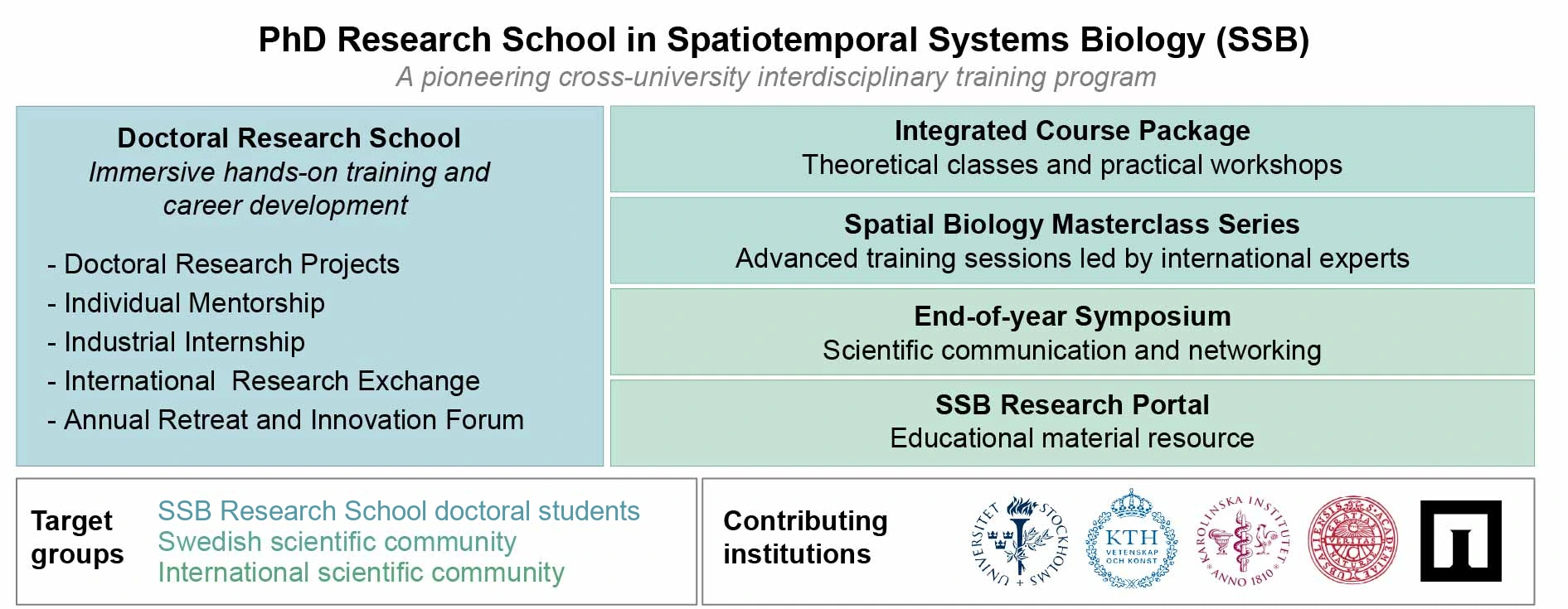
The PhD Research School in Spatiotemporal Systems Biology (SSB), a pioneering cross-university interdisciplinary training programme. The Doctoral Research School offers immersive hands-on training and career development: doctoral research projects, individual mentorship, an industrial internship, an international research exchange, and an annual retreat and innovation forum. Alongside it run the Integrated Course Package of theoretical classes and practical workshops, the Spatial Biology Masterclass Series of advanced sessions led by international experts, an end-of-year symposium for scientific communication and networking, and the SSB Research Portal of educational material. Target groups: SSB doctoral students, and the Swedish and international scientific communities. Contributing institutions: Stockholm University, KTH, Karolinska Institutet, Uppsala University and the Institute for Futures Studies.
The main educational activities of the research school. Open full size

Explore the research school

  • Each proposed project fosters a collaboration between at least two research groups within the cluster or involves an industry partner. The main supervisor works alongside co-supervisors from other cluster groups or an industrial collaborator.

    • Technology development or experiments across multiple spatial molecular platforms.
    • Computational analysis or modelling of real spatial data.
    • A defined biological application at the frontier of current research.
    • A steady route towards doctoral milestones.
  • Ten courses, each lasting one to two weeks (1–2 ECTS), combine lectures with hands-on training in key spatial biology technologies and applications, and provide foundational knowledge of innovation pathways and the ethical, legal, and social implications (ELSI) relevant to the field. In addition to doctoral programme students, each course welcomes 20 external participants from Swedish universities.

    1. 01

      Transcriptomics-based spatial biology

      Planned lead: Mats Nilsson

    2. 02

      Spatial multi-omics technologies

      Planned lead: Joakim Lundeberg

    3. 03

      Cellular lineages in space and time

      Planned lead: Emma R. Andersson

    4. 04

      Machine learning and AI in spatial biology

      Planned lead: Carolina Wählby

    5. 05

      Spatial biology of the immune landscape

      Planned lead: Camilla Engblom

    6. 06

      Spatial biology of host-microbiome interactions

      Planned lead: Eduardo Villablanca

    7. 07

      Translational spatial biology

      Planned lead: Niklas Björkström

    8. 08

      Planetary spatial biology

      Planned lead: Stefania Giacomello

    9. 09

      From data to society: ethics and impact in spatial biology

      Planned lead: Heidi C. Howard

    10. 10

      From discovery to product through the Swedish innovation landscape

      Planned lead: Daniel Carlsson

  • Each doctoral student is paired with an academic or industry mentor from the cluster’s network. Meetings scheduled twice a year support scientific development, new connections and informed career choices within and beyond academia.

    Part of an integrated approach beyond core research and technical training towards broader professional and career development.

  • A one- to three-month placement with a partner company provides doctoral students with hands-on experience in innovation, product development, and the real-world application of spatial biology, while allowing them to explore career opportunities beyond academia.

    Part of an integrated approach beyond core research and technical training towards broader professional and career development.

  • A scholarship supports a three- to six-month stay with an external partner laboratory abroad to build technical skills, support knowledge transfer, and create and strengthen long-term international connections.

    Part of an integrated approach beyond core research and technical training towards broader professional and career development.

  • A two-day gathering brings the cluster community together for collaborative challenges and industry-facing pitches, alongside communication, leadership, grant-writing and career development training.

    Part of an integrated approach beyond core research and technical training towards broader professional and career development.

  • The research school shares its expertise beyond its doctoral programme through three open formats:

    • The Spatial Biology Masterclass Series: a flagship initiative featuring one-day events each semester, where internationally renowned experts deliver lectures and hands-on computational training in the latest spatial biology technologies and analytical approaches.
    • The SSB Symposium: an annual conference featuring internationally renowned invited speakers and highlighting the latest advances and emerging trends in spatial biology.
    • The SSB Research and Education Portal: an open resource for teaching materials and scientific updates from the cluster.

Planned programme · Details subject to development

A training programme the field does not yet have.

Where the field stands

Over the past decade, spatial biology has moved from a method-driven niche to a central pillar of data-driven life science. DNA, RNA, proteins, lipids and metabolites can now be measured in intact tissue, alongside imaging, with rapidly improving resolution and scale. Genomic methods for lineage tracing add cellular ancestry to that picture, giving a pseudotemporal frame for how tissues form and remodel. AI has opened what none of those measurements reach alone: three-dimensional, temporal and histological integration of spatial data, prediction of molecular features that were never measured, and using these data to model how cells shift, interact and organise.

The toolkit’s reach has expanded accordingly. Spatially resolved analysis now offers a common framework for human tissue, animal models and in vitro systems such as stem-cell-derived organoids. In medicine it is moving past discovery toward diagnostic markers and therapeutic targets read in their full spatiotemporal context. In planetary biology it is being adapted for plants and their microbial communities, non-model organisms, and life under environmental extremes, including spaceflight. Commercialisation of the platforms, together with open datasets and analysis pipelines, has broadened their accessibility and use across the research community.

The gap this school would fill

That expansion has created a demand the education system has not answered. The field needs scientists who can work across technology development, data science, biological application and interpretation at once, with an understanding of how a method becomes a product and how the opportunities and challenges of this field can be turned into societal benefit. At the same time the user base has grown well beyond method developers, to clinicians, diagnostic professionals, translational researchers, computational specialists and industry teams who need structured, task-oriented training rather than improvised apprenticeship.

Neither in Sweden nor internationally does a structured, comprehensive training programme in spatial biology currently exist. Early-career researchers are therefore underprepared for roles that the field is already creating. Sweden is uniquely positioned to address this gap: the cluster’s investigators have helped shape the field, while the country benefits from an established innovation ecosystem and strong industrial leadership in spatial biology. Establishing the Research School in Sweden would position the country at the forefront of spatial biology education and set a new international standard for interdisciplinary training in the field.

What we propose to build

The PhD Research School in Spatiotemporal Systems Biology is a cross-university doctoral programme and a national education hub, run across KTH Royal Institute of Technology, Stockholm University, Karolinska Institutet and Uppsala University, and the first of its kind on the international stage.

It is designed for two audiences at once. A doctoral cohort would take a full, multi-layered path through the field, from technology development and cross-platform experimental design to advanced data analysis, biological interpretation and translational innovation. The wider Swedish research community would have access to the same courses, masterclasses and events, so that national competence grows faster than any single cohort could carry it.

What a graduate would carry

The parts of the programme are different routes to one set of capabilities. Doctoral graduates leaving the school would be expected to have:

  1. A firm grasp of the conceptual and technological foundations of spatial biology.
  2. Insight into how biological systems are organised across space, time, and scales.
  3. Hands-on methodological exposure to multiple spatial technologies, rather than one platform.
  4. Structured bioinformatic and computational training, with an emphasis on reproducible, scalable, transferable and interpretable workflows.
  5. Awareness of the ethical and societal considerations in spatial biology research, including AI-based approaches.
  6. A working understanding of the Swedish innovation and industry landscape.
  7. Readiness to apply the spatial biology toolset across unfamiliar biological contexts.
  8. The ability to collaborate and exchange knowledge across laboratories and disciplines.

Part of a larger plan

The school is not a satellite of the cluster’s research. Doctoral projects are drawn from the research plan, and the students act as integrators between collaborating groups through jointly supervised work. Their innovation activities and industrial placements deepen the cluster’s engagement with partner companies, as set out in the innovation plan. The three parts are designed to feed one another in both directions.

Taken together, the aim is straightforward: to train people who can shape the next era of spatial biology in both academia and industry, and to keep Sweden at the forefront of the field.

Planned programme · Details subject to development