
Why this cluster
From spatial maps to predictive biology.
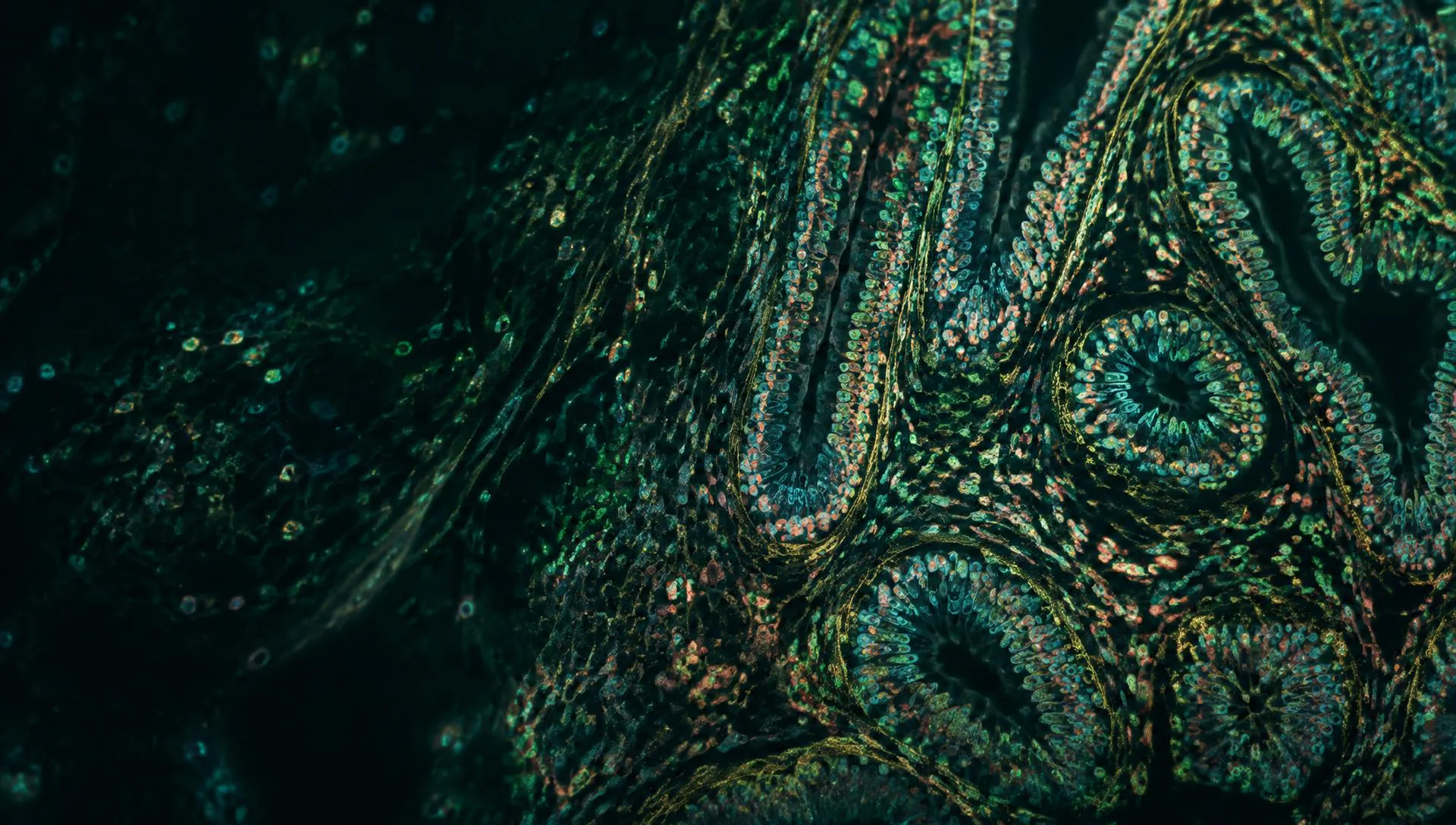
Spatial biology has transformed what we can see. We can now capture extraordinarily detailed molecular snapshots of intact tissues, showing not only which cells and molecules are present, but where they are and how they interact. ESBT members in Sweden pioneered foundational technologies that created this field. Yet we have only begun to exploit what they make possible.
Today's spatial technologies are simultaneously extraordinarily powerful and fundamentally limited. A single tissue section can generate an unprecedented wealth of molecular and spatial information, but its complexity means we are not yet extracting its full value. Current technologies already hold enormous unrealised potential for healthcare, drug development, biotechnology and other industries. Yet this remarkably detailed view is still largely a static, two-dimensional snapshot, generated using technologies that remain difficult to scale beyond specialist environments. The opportunity is therefore twofold: to unlock the value already contained within today's spatial data, and to invent what comes next: scalable spatial biology in three dimensions and over time, with richer combinations of measurements, and coupled to AI capable of learning from this complexity.
Why does that matter?
What if apparently healthy tissue could reveal disease before pathology becomes visible? Could the organisation of a tumour predict which treatment will work for an individual patient? Could thousands of snapshots of development be combined into a virtual embryo that predicts what happens next? Could we predict which trees will remain resilient decades into a changing climate? These are not simply problems of collecting more data. They require us to turn complex biological information into understanding and prediction.
Our integrated approach
ESBT's strength is that it is one interconnected research and innovation system, built by leaders across spatial technology development, AI, medicine, biology, engineering, healthcare, industry, research infrastructures, social sciences and the public sector.
Commercialisation and implementation are not downstream activities at ESBT; they are drivers of our research and technology development. Biological questions reveal what our technologies still need to measure. Healthcare and industry identify what technologies must deliver to become useful products and services. Technology developers create new capabilities; AI makes their complexity interpretable; applications reveal new opportunities and limitations. This continuous feedback between invention, discovery, innovation and implementation will accelerate both scientific advancement and routes to real-world use. Social-science expertise and our doctoral school are embedded within this ecosystem, building the skills, governance and trust needed to translate technological advances into responsible real-world use.
Like cells within an organism, ESBT's components have different capabilities, but their interactions create functions that none can achieve alone. Shared infrastructure, data and expertise allow discoveries, technological advances and real-world needs to continuously shape one another.
Ambition to impact
Our ambition is to move spatial biology from describing what is there, to understanding why, and predicting what happens next. In doing so, we aim not only to open new possibilities in disease prediction, precision medicine, human development and climate-resilient biology, but to translate Sweden's pioneering scientific position into new technologies, companies, partnerships and applications - establishing Sweden as a leading international environment for the next era of spatial biology.