
From spatial biology to societal benefit.

Spatial biology that benefits everyone, safely and fairly.

Spatial biology can bring earlier and more specific diagnosis, better stratification of patients and fewer ineffective treatments, and further ahead help with food security, pandemic resilience and climate change.

To get there, research and guidance on the ethical, legal and social aspects (ELSA) of spatial biology run through the cluster from day one, led by Heidi Howard and Pontus Strimling. This work runs through both the cluster’s research programme and its innovation programme, from studying trust and adoption to supporting partners, patients and policy-makers. Social science research will also forecast where spatial biology can meet the greatest societal need, and those findings will continuously steer the cluster’s research direction.

Mapping the field and assessing which applications are ready.

Charting the spatial biology ecosystem in health care, agriculture and planetary biology: the key actors, how data flows, and what helps or hinders translation. Interviews with experts and the public will examine transparency, consent, communication and the role of AI, while an assessment of readiness and disruptiveness separates applications close to deployment from longer-term opportunities. The results guide which technologies and applications the cluster prioritises.
Identifying the regulatory and practical barriers to adoption.

Analysing the regulation that governs how spatial biology reaches health care, agriculture and planetary biology, and how procurement, reimbursement, professional norms and commercial incentives shape uptake. The work will identify where rules lag behind the technology, weigh agile options such as regulatory sandboxes against privacy, equity and safety, and measure what builds trust among the people expected to use it. It also covers public–private and IP arrangements that keep publicly funded reference data a national asset while still enabling commercialisation. Partners and start-ups use these findings to plan how new tools reach the market.

Weighing societal benefits against risks.

Assessing who will gain access to new spatial diagnostics, and weighing interventions by health gain, cost and risk. Two high-stakes areas are addressed directly: where spatial biology can cut the climate footprint of biological production, and, with the Swedish Armed Forces, how rapidly deployable tools could identify and counter antimicrobial resistance in crises. Uncertainty and dual-use risks are assessed alongside. This helps make sure new diagnostics reach patients beyond the best-resourced centres.

Connecting the cluster with patients, the public and policy-makers.

As innovations move through the cluster, structured engagement with patients, clinicians, the public and policy-makers, together with current intelligence on the conditions for adoption, turns the research into inputs that the cluster and external decision-makers can act on. A dedicated ELSA implementation and policy officer will integrate these considerations across the cluster.

  • Stakeholder workshops and public communication with the Institute for Futures Studies
  • Consent templates, data-stewardship protocols and adoption checklists
  • Monitoring of regulation, public attitudes and adoption conditions
  • Policy briefs to Swedish and EU bodies, and annual reporting on impact
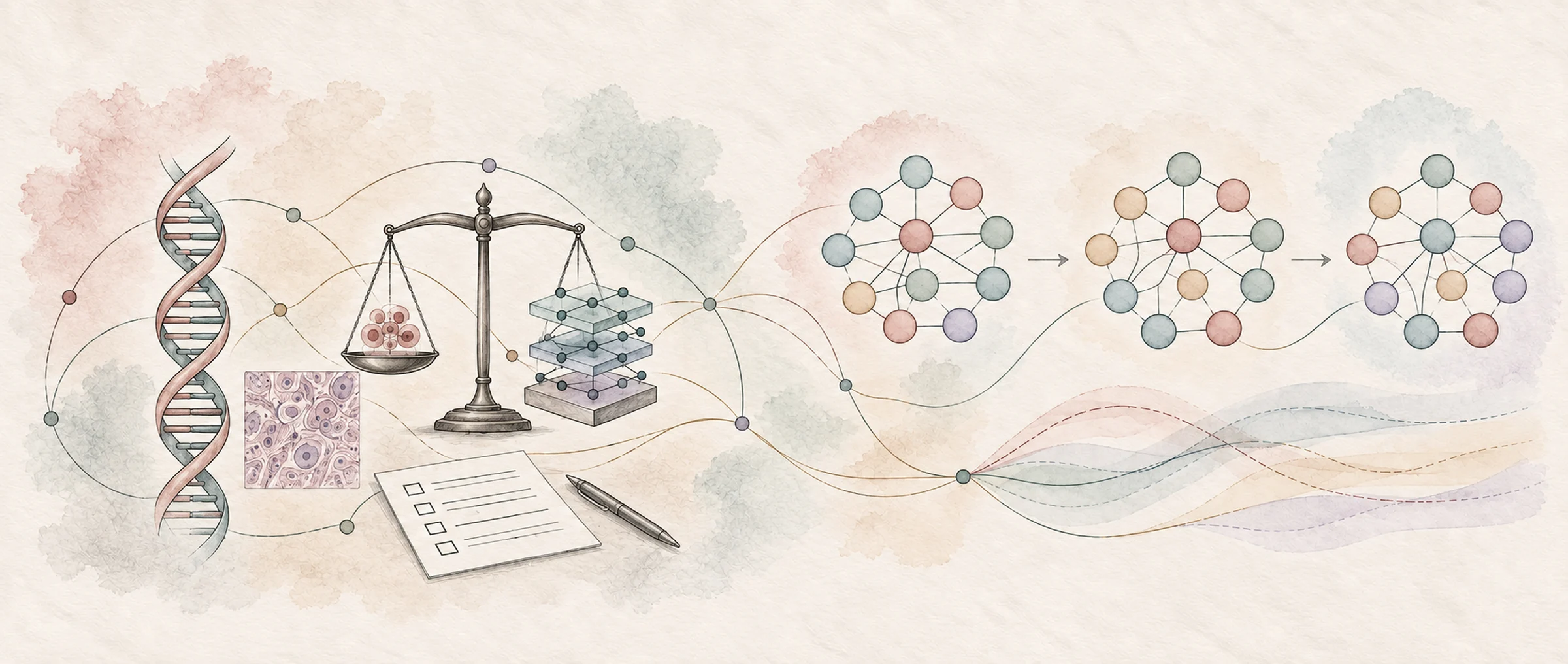
Watercolour and ink illustration: a DNA helix, a stained tissue square and a consent form beside a balance weighing cells against the layers of a neural network, with threads running out to social networks whose members shift colour as opinion spreads.

The research it builds on.

Heidi Howard and Pontus Strimling lead the cluster’s ethical, legal and social research, building on their work on genomic consent, public engagement and how opinions and norms change.

Ethics and Governance

Heidi Howard studies the ethical, legal and social questions that follow new genomic technologies: whether consent is adequate when companies sell whole-genome sequencing directly to consumers, what gamete donors are told when their cells are used for germline genome-editing research, and how public engagement can empower citizens rather than serve experts' agendas. Her work also examines ethical and dual-use risks of AI systems used in biology.

Modelling Social Change

Pontus Strimling builds formal models of how opinions and norms change. Positions better connected to harm and fairness arguments tend to gain support over time, a theory used to forecast how US public opinion on moral issues will shift up to 2030, and studies across 57 societies map how people judge norm violations and the responses to them. The same tools can help anticipate how the public will respond to new spatial biology applications.